
You're getting stronger. But how strong is enough?
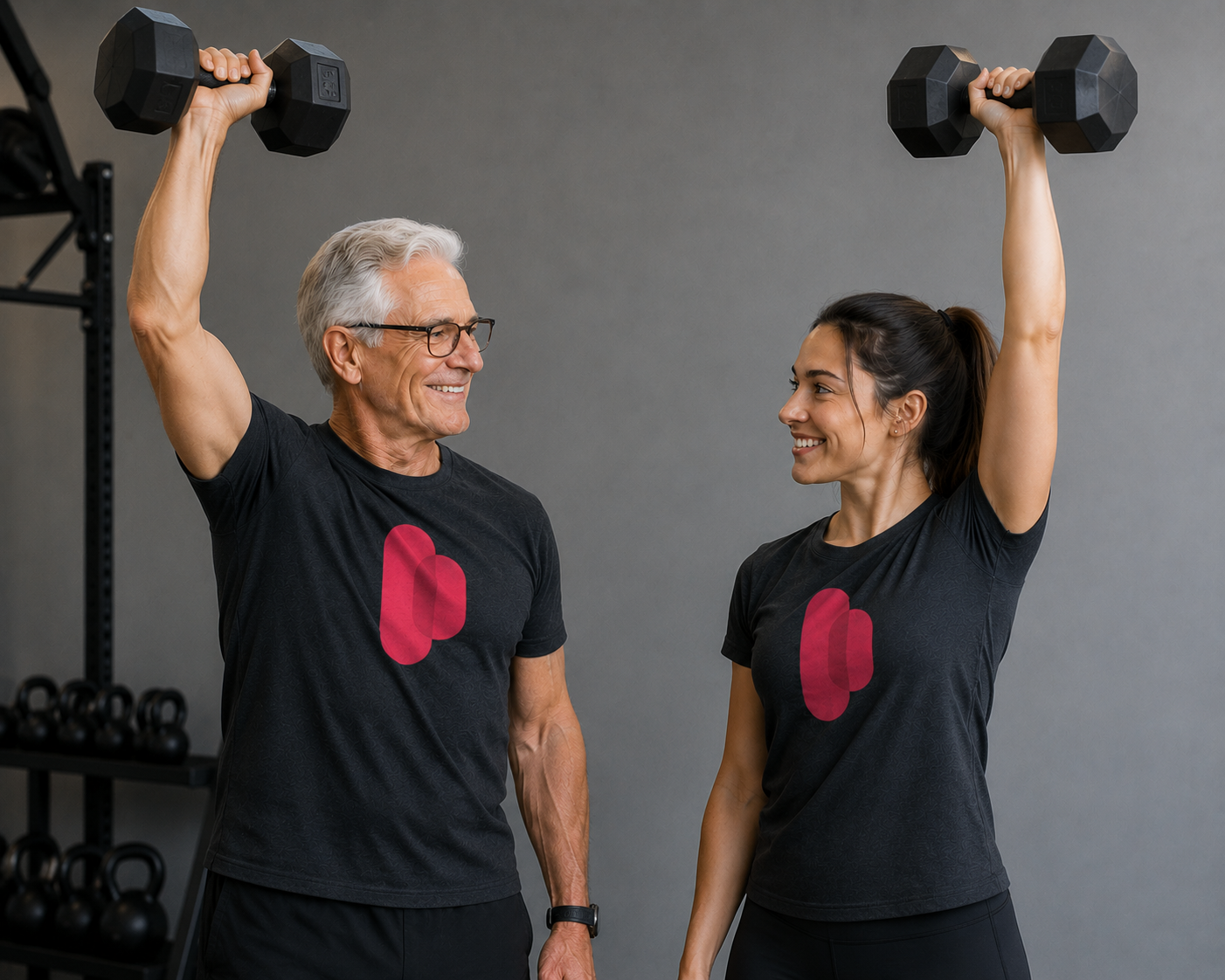
Who is stronger? Cadent’s Strength Level can tell you.
You can feel some progress. The weights are going up a bit. But how do you know how you’re really doing?
Going to the gym consistently and adding weight to the bar over time is what you are supposed to do. But how strong are you, relative to where you ‘should’ be? Not relative to the biggest person in the gym. Not relative to some idealised number from a Reddit thread. Relative to a standard that accounts for who you actually are.
There is a growing movement in health and fitness built around exactly this kind of question. Whoop, Oura, and a wave of longevity-focused tools now give people a biological age score: a single number that tells you how your body is actually performing relative to your chronological age. People find it compelling because raw data on its own doesn’t tell you much. Context is everything.
Cadent’s Strength Level applies the same principle to your training. The problem with raw kilograms is that they carry no context. A 90kg man lifting 100kg and a 62kg woman lifting 70kg have both done serious work. But the numbers alone tell you nothing meaningful about either of them. Heavier people on average lift more weight.
Strength Level solves this with the same approach used by sports scientists and competitive powerlifting federations: personalised, scaled scoring that puts everyone on the same meaningful scale.
The biology of strength
There is a principle in biology called allometric scaling. It explains why an ant can carry fifty times its own bodyweight while an elephant, despite being the strongest land animal on earth, can lift only about a quarter of its mass. It seems counterintuitive, but strength doesn’t scale linearly. Smaller animals are always proportionally stronger than larger ones.
The same principle applies to human animals! A lighter person who squats an impressive weight relative to their body size is not "almost as strong" as a heavier person lifting more in raw terms. They may be considerably stronger if the comparison is fair. Allometric scaling adjusts for this and makes fair comparison possible.
Cadent also factors in age. Strength peaks in the late twenties and early thirties, then declines over time. A 50-year-old hitting a personal best is doing something that deserves proper credit. Age coefficients, from the same models used in powerlifting, ensure the score reflects your stage of life. Biological sex is also factored in, since this also significantly affects strength benchmark.
The result is a score built around you, not a generic average.
Three lifts. One honest picture.
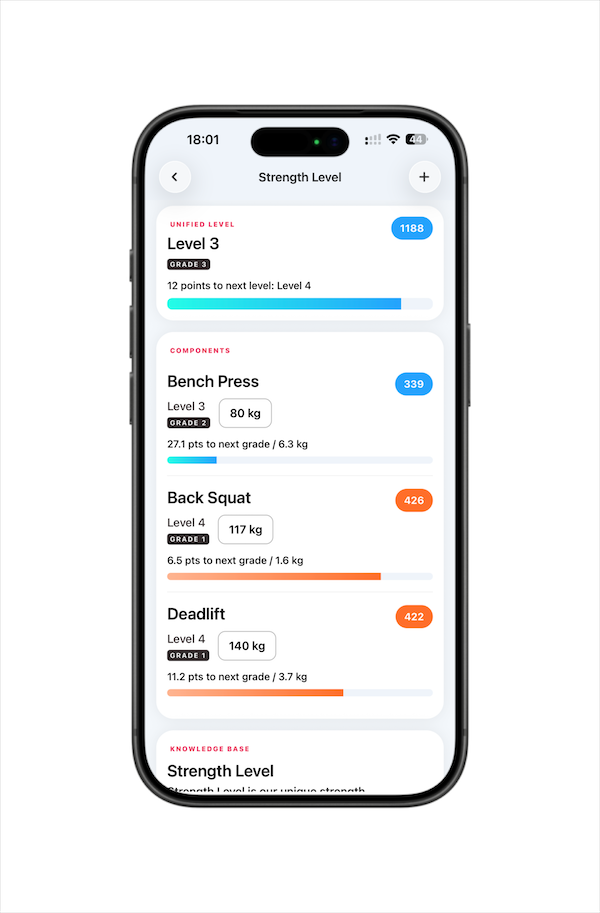
Strength Level is built on three pillar exercises: Back Squat, Deadlift, and Bench Press. Barbell only. Between them, they cover the whole body. The squat tests your legs and lower back. The deadlift tests your posterior chain: hamstrings, glutes, and the muscles that run up your spine. The bench press tests your chest, shoulders, and arms. All major muscle groups are covered. This is why powerlifting has always used these three as the definitive test of overall strength, because someone who is genuinely strong across all three is genuinely strong. A big bench press with weak legs is a start. All three together is a balanced approach. The barbell requirement matters. Other equipment changes the mechanics enough that the numbers are not comparable. Consistency is what makes the score meaningful.
Each pillar produces a score against your personalised scale. The sum of all three to give you a unified Strength Level, placed in one of seven levels from 0-6. Each tier has three sub-grades (I, II, III), so you always have a clear marker of where you are and a precise sense of how far to the next step.
Size is not the same as strength
This is worth saying directly, because it is easy to forget in a gym environment where aesthetics dominate the conversation.
Not everyone training hard is chasing bigger muscles or a certain look. Plenty of people train to be genuinely stronger, to stay capable as they get older, or simply because the gym is where they find focus. For those people, Strength Level is more meaningful than a mirror.
It also reframes what "strong" looks like. A leaner person at Intermediate might be considerably stronger, by any honest measure, than a larger person at Novice. The score does not care about appearance. It cares about what you can actually do relative to your body, your age, and your sex. That is a more interesting and more useful number.
What the tiers actually mean
Just getting to Level 1 already puts you roughly in the top 50% of the general population. Level 2 is top 30%, so that represents meaningful progress. Getting to a higher level requires sustained, consistent training. The higher levels are for long-term commitment, something to aim for - but only if that motivates you.
Coming soon: see how you stack up with people you actually know
Strength Level becomes even more interesting alongside people you train with. This week, Cadent is launching Teams: a new feature that lets you invite friends, share your training activity, and see each other's Strength Level on a shared leaderboard. There is also a Strain leaderboard, rewarding training effort and consistency alongside raw strength. And when someone hits a PR, you can give them a “like” directly from the feed.
It is not about competition for its own sake. It is about having people around you who make the process more motivating. A friend at Level 6 is not intimidating. They are proof of what consistent training actually looks like over time.
More on Teams in the next post.
Finding your level
Strength Level is live in Cadent now. If you have logged a barbell squat, deadlift, and bench press, your score is already being calculated. Head to the Strength Level screen to see your tier and your sub-grade for each pillar.
If one of the three is missing, that is your next target. You can do a specific lift test from the Strength Level screen in your next session.
