
Find your Cadent — Why Training Needs a Rhythm, Not a Routine

Do you feel bored and flat in the gym? Here’s how to solve that.
If you walk into any commercial gym today, you will see the same thing happening over and over again. People walk in, trudge over to the same machines, do 3 sets of 10, maybe followed by a plod on the treadmill, and go home. For the first few months, this does something. But your body adapts, it gets used to the routine and you’ll see virtually no change over time.
There is a reason professional athletes don't train this way. They use a concept called periodisation — systematically varying training over time so the body is always being challenged, but never overwhelmed.
In Cadent, we call it your Training Cycle. It is the core of every training plan, and it is the reason we get so much positive feedback about how different this is compared to a generic plan, or winging it every session.
Why you can't give 100% every day
A common trap in fitness is the belief that every session must be a maximum effort. If you aren't leaving completely exhausted, it didn't count — right?
Wrong.
Training at your absolute limit every single week means your body never gets the chance to recover and rebuild. You will eventually burn out, get hurt or just quit because it’s too much
By training in a 4-week cycle — Volume, Build, Peak, Adapt — you vary your sessions in a way that works with your body rather than against it.
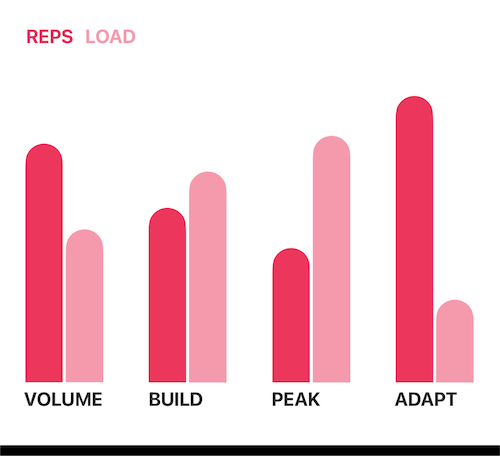
The four block cycle that underpins all training plans on Cadent
In Week 1, you build your foundation with higher reps and moderate weight. By Week 3, your body is primed to safely push its limits. In Week 4, you ease back with lighter work, allowing your muscles to repair and grow stronger.
You can push harder at the right moments precisely because you are resting strategically at others.
Why this matters beyond the gym
You don't need to be training for competition for this to make a difference. The biology of human recovery applies to everyone. Building a rhythm into your training brings three things that most programmes overlook:
A clear sense of purpose each session. When you walk in, you know exactly what the day is for — are you pushing hard today, or putting in solid, steady work? That clarity makes training feel less like a chore.
Natural variety that keeps things interesting. Rep ranges, rest periods, and focus shift from week to week. The core movements stay consistent, but the stimulus changes — which is what your body and mind need to stay engaged.
A rhythm you can actually sustain. Training, like most things in life, works best when it has an ebb and flow. That natural cadence — of effort and recovery, of pushing and pulling back — is where the name Cadent comes from. The goal isn't to exhaust yourself. It's to find a rhythm you can maintain for the long term.
How Cadent makes this personal
Most training programmes live on rigid spreadsheets. Miss a session and the plan falls apart. Cadent was built to bring this approach to everyday life, with the flexibility that it actually requires.
Your schedule is completely adaptable. If you’re training four days a week but can only manage two this week, it doesn’t matter. You’ll see you’re a bit behind schedule (a bit of pressure can be a good thing), but at any time you can skip to the next block, restart the block, or restart the cycle.
Each training cycle is highly personalised for you. It’s tailored to your goal — whether that's building pure strength, building and shaping or muscular endurance — and filtered by the equipment you actually have available. You can also adjust the balance: increasing or decreasing the focus on specific areas of your body. Perhaps most important of all, you can choose your schedule: do you want only one full body session per week, or six highly targeted sessions per week?
And when it comes to progression, there is no pressure. Cadent looks at your past performance and suggests a sensible starting point for the day. If you are tired, stressed, or simply having an off day, you lift what you can. The app tracks your reality, adjusts accordingly, and never pushes you into a lift you aren't ready for.
216,000
Without even considering equipment options, there’s well over 216,000 cycle combinations. If you factor in equipment selection the number has quadrillion in it, which definitely means you won’t run out of options.
It is the science of strength training, adapted for the way real people actually live.
