
Version 1.1— Balance & Rep Progression
Cadent has one primary goal: bringing intelligent, effective coaching to the everyday athlete. That can mean many things, but it doesn’t just mean an AI talking to you and pretending it’s a person. Sometimes coaching can be a simple nudge, a tip or suggestion. Or it could be a different way of looking at your data that guides your future actions. Version 1.1. The latest release of Cadent brings new features that improve the coaching capability, but also unlock more ways to train and also boost your efficiency in the gym, making your workouts more frictionless than ever. Here are the headlines of v1.1.
⚖️ Training Balance: Build a physique with more real-world resilience
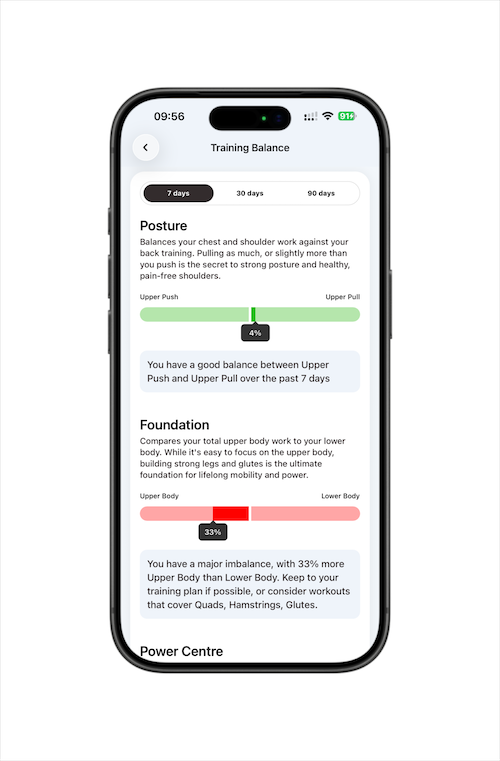
Most fitness apps track what you lift. Cadent now tracks your physical symmetry across several meaningful and important movement axes with a new feature called Training Balance. By tracking your Strain over 7, 30, and 90-day trends, Cadent highlights imbalances. You can now keep track of:
The Posture (Upper Push vs. Upper Pull)

Are you doing too much bench pressing and not enough rowing? Pay attention to the balance of these, as it has an impact on your postural health. Most people in desk jobs tend to hunch over a keyboard, developing rounded shoulders and increasing the risk of shoulder impingement and other injuries.
The Foundation (Upper vs. Lower Body)

Ensure you aren't skipping leg day and are building lifelong mobility. Sarcopenia (age-related muscle loss) disproportionately affects the lower limbs. The loss of leg and glute strength is the single highest predictor of losing physical independence, suffering a bad fall, and all-cause mortality in adults over 60. Besides which, training the biggest muscles in your body has the positive side effect of boosting your body’s growth hormone production, which improves your overall training effectiveness. Nobody should skip leg day, whether you’re 20 or 80 it’s important to exercise your whole body.
The Power Centre (Front vs. Back of Legs)

Balancing your thighs (quads) against your glutes and back of legs (hamstrings) helps to protect your knees and lower back. The quads are naturally stronger, but many gym routines (and sitting all day) create "quad dominance." When the quads overpower the hamstrings, the knee joint isn’t so well protected, which can just lead to knee pain, but could also increase your risk of knee ligament (Anterior Cruciate Ligament or ACL) tears. Plus, weak glutes mean that when you lift something, more of the work is done by your lower back (lumbar spine) – and we all know what can go wrong there.
360° Core Stability
This one helps ensure your lower back matches your abdominal strength. The fitness world is traditionally obsessed with the "six-pack". But the core is actually a 360-degree muscular cylinder designed to resist motion and protect the spine. If you only work abs and neglect spinal erectors (lower back), the cylinder is weak.
🏋️ True Volume: Weighted & Assisted Exercises
A pull-up does not equal 0kg of volume. In Version 1.1, we upgraded the metrics engine to include support for body weight, weighted body weight, and assisted machine exercises.
If you weigh 80kg and strap a 10kg plate to your waist for dips, Cadent now accurately factors your body weight into your Total Volume and Estimated 1-Rep Max (e1RM) calculations. In the same way, if you use the assisted pull-up machine, your load is calculated by deducting the assist weight from your body weight. So you can progress from beginner to elite, and track your progression all the way.
📈 Smart Rep Progression (AMRAP)
Some exercises involve moving some or all of your body weight, which means it’s harder to recommend how many reps you should do. You can’t vary your body weight like you can with a pin loaded machine! For these exercises (for example a push-up), once you modify how many reps you can manage the training engine learns from your past workouts, and will adapt the suggested reps for future sessions.
⚡ Frictionless Workouts: Inline Set Editing
We’ve introduced Inline Set Editing, allowing you to change your reps and load for any exercise, during a live workout. It keeps you in the flow state and also means that you can correct sets that you’ve already completed. Gotta make sure your data is right!
✨ Polish, UI & UX Enhancements
New Welcome Walkthrough: A beautifully redesigned visual guide to help new users understand what the app is all about.
Ready to check your Training Balance?
Update to Version 1.1 in the App Store now. Your feedback drives our roadmap, please use the Whatsapp group or the support feature to share your thoughts.
