
The Science of Strain: How to Balance Recovery and Progression in Strength Training

If you ask someone how their workout was, the answer is often very generic, like asking them how they are. But how do you know if you actually had an effective workout? Being in the gym for an hour does not equal a good session. Cadent provides several features that help you train more effectively, and that doesn’t just mean training harder.
Many of us have to balance everything in a busy life, so just making it to the gym feels like an achievement. Once through the door, however, too many people fall back into the same old routine. It doesn’t really produce results, it becomes boring and repetitive, and it can even lead to muscular imbalances and injuries.
To build strength and change your physique, you need to navigate the right path. You need to push hard enough to force your body to adapt, but you must rest long enough for that adaptation to actually happen.
In Cadent, this balancing act is solved with a metric called Strain. Here is why we built it, how it works, and why it’s so useful.
The Two Goals of Strain
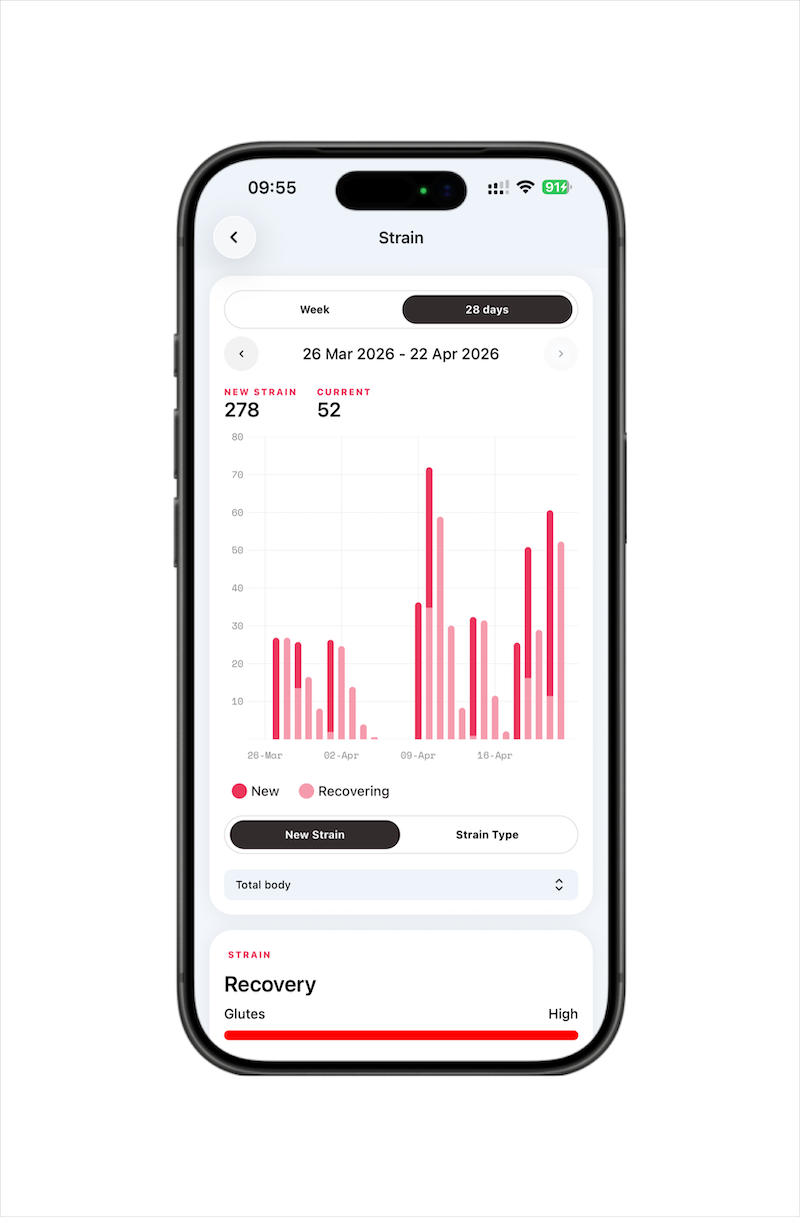
Strain acts as your body’s personal fuel gauge, serving two critical day-to-day purposes:
1. Preventing Overtraining
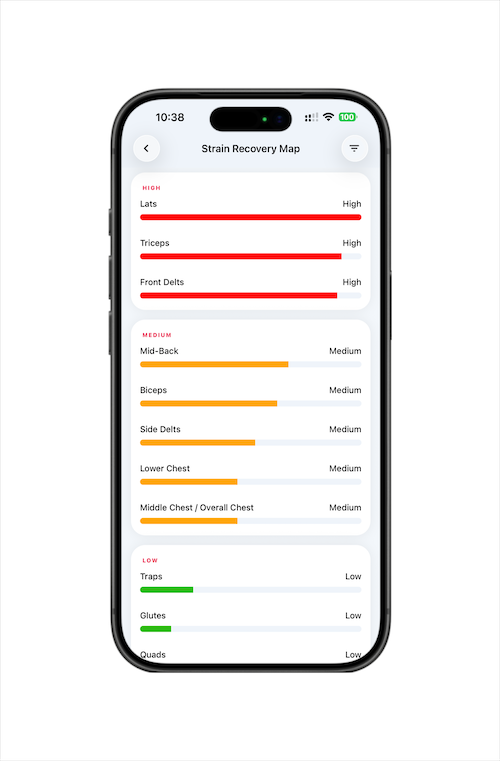
More is not always better. If you hammer your legs on Monday, hitting them again on Tuesday or Wednesday doesn't build twice the muscle; it interrupts the repair process. Strain acts as a guardrail. If you open the app and your legs show a high Strain level, you’ll be warned against doing another heavy session, helping you avoid burnout and injury.
2. Ensuring You Train Enough
On the flip side, our bodies are very efficient. If you don't apply enough stress, you won't see change, or “adaptation” as it’s called. Strain allows you to look back and see if you actually trained your legs regularly, or if you skipped leg day a couple more times than you thought.
How Cadent Calculates Your Strain
It’s not a case of just counting your reps or looking at the total weight lifted. Cadent looks at the biological cost of your workout. Without going too deep, it’s driven by a few key scientific principles:
Biomechanics: Not all exercises are created equal. A heavy barbell squat creates a massive amount of systemic fatigue that is distributed across your quads, glutes, and lower back. A bicep curl, however, directs almost 100% of the effort straight into one muscle. Cadent knows the difference and calculates strain accurately by taking this into account
Periodisation: The app knows what phase of training you’re in. For example if it’s a deload week, it scores the strain accordingly, reflecting the relative effort level of the session.
Type of Strain: Cadent also tracks how you are fatiguing the muscle. Lifting heavy weights for low reps creates Mechanical Strain (taxing your Central Nervous System). Lifting moderate or lower weights for higher reps creates Metabolic Strain (the "muscle burn" associated with building shape and endurance). Your workouts will be tuned automatically based on your goal, but you can look at Strain broken down by each type to see if you’re been on the right track over time.
The Soreness Myth
Maybe you’re wondering: can't I just go by how sore I feel to know if I can train my legs again?
This is one of the biggest traps in fitness. Delayed Onset Muscle Soreness (DOMS) - that soreness you feel, typically peaks 24 to 48 hours after a tough session. But soreness is not an accurate indicator of recovery.
Research has shown that a muscle can feel completely pain-free, yet still not be recovered at a cellular or neurological level. Your Central Nervous System (CNS) might still be exhausted even if your legs feel fine. Conversely, you can feel slightly stiff but actually be primed and ready for a great workout.
Cadent models the decay of your fatigue over several days across each muscle group, giving you an insight that goes beyond how sore you’re feeling.
The Big Picture: Training Balance for Real Life
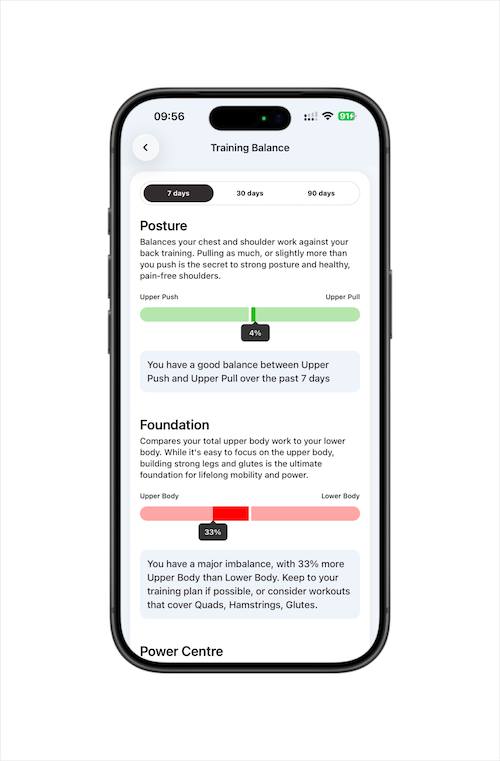
Tracking daily fatigue is crucial, but looking at your Strain data over 30 or 90 days unlocks something even more important: Training Balance.
Most fitness apps will just show you a generic pie chart of the muscles you trained. Cadent groups your accumulated Strain into four movement axes that directly impact your real-world health and longevity, for example: Posture Balance (Upper Push vs. Upper Pull): If you sit at a desk all day, your shoulders are naturally pulled forward. If you go to the gym and accumulate massively more strain on your chest (pushing) than your back (pulling), you may actively worsen this posture, leading to shoulder pain. Posture Balance highlights this so you can correct it.
Intention vs. Reality
When you set up your profile on Cadent, you use the Balance Dials to tell the app your intentions (e.g., "I want to do extra glute work and less on my shoulders").
But your Strain and Training Balance data is your reality.
Did you actually balance out your posture over the last 90 days like you planned to? By combining the intelligent planning of the Balance Dials with your actual Strain data, Cadent closes the loop. It ensures that you aren't just going to the gym, you are training with intelligence, flexibility, and purpose.
